


HaploX Collaborates with Sichuan Cancer Hospital, West China Hospital, and University of Electronic Science and Technology of China to Publish a Paper in STTT, a Sister Journal of Nature
Signal Transduction and Targeted Therapy, 2022
Characteristics and significance of peripheral blood T-cell receptor repertoire features in patients with indeterminate lung nodules
Led by Dr. Shifu Chen, CTO of HaploX, the technical team joined forces with teams from Sichuan Cancer Hospital, West China Hospital, and the University of Electronic Science and Technology of China to publish the academic paper "Characteristics and significance of peripheral blood T-cell receptor repertoire features in patients with indeterminate lung nodules." The paper was published in STTT (Signal Transduction and Targeted Therapy), a journal under the Nature portfolio (IF = 38.1), demonstrating the preliminary potential of HaploX’s TCR-based and other technologies for the auxiliary diagnosis of benign versus malignant lung nodules. Meanwhile, a phase II expanded-cohort multicenter study is already underway and progressing smoothly.
Background
Lung cancer is one of the most common cancers and a leading cause of cancer-related deaths. T cells are known to play a significant role in the destruction of cancer cells and have therefore become the focus of lung cancer immunotherapy. T-cell receptors (TCRs) can recognize antigenic peptides presented by HLA proteins. TCRs are distinct individually and vary with pathophysiological condition, so T cells can respond to a wide range of antigens. TCR repertoire diversity reflects the potential for cellular immunity, and several studies have shown that the diversity of the complementarity-determining region 3 (CDR3β) is important in cancer treatment and prognosis. Studies have shown that CDR3β diversity in patients with advanced lung cancer differs significantly from that in healthy individuals.
Methods
Here, we have developed a novel model called "TCRnodseek" based on the repertoire properties of TCRs in peripheral blood, which can accurately classify small pulmonary nodules into malignant or benign types. This prospective study was initiated at Sichuan Cancer Hospital, and the study workflow is shown in Figure 1a.

(Figure 1a)
We described the major clinical features of 109 patients and performed TCR sequencing analysis on their peripheral blood. Among them, 99 patients with indeterminate lung nodules are the main research subjects. The number of male and female subjects is comparable (male 52; 52.5%), the mean age is 55.5 years, and the mean size of indeterminate lung nodules is 13.7 mm. There are two independent groups of patients enrolled in this study (a discovery group and a validation group). We extracted DNA from their peripheral blood samples and analyzed their TCR repertoires.
Results
Significant differences were observed in the Shannon index, evenness index, Simpson index, and clonality index between the benign group and the stage I lung cancer group (p = 0.01, p = 0.0071, p = 0.01, p = 0.01; Figure 1f). ROC analysis was used to determine the diagnostic value of the above features, and the AUC of each feature was higher than that of previous nodule diagnostic methods (Figure 1g). In addition, we added several important clinical features for the diagnosis of lung nodules to the candidate feature list. Random forest and information gain methods were applied to select the top three vital features (ground glass nodule, Shannon index, and evenness index) to distinguish benign from malignant lung nodules (Figure 1i). GGN (ground glass nodule) is the most important feature. The Shannon index can serve as a useful complementary indicator for non-GGN indeterminate lung nodules (p = 0.01, Figure 1h), which is consistent with previous studies.
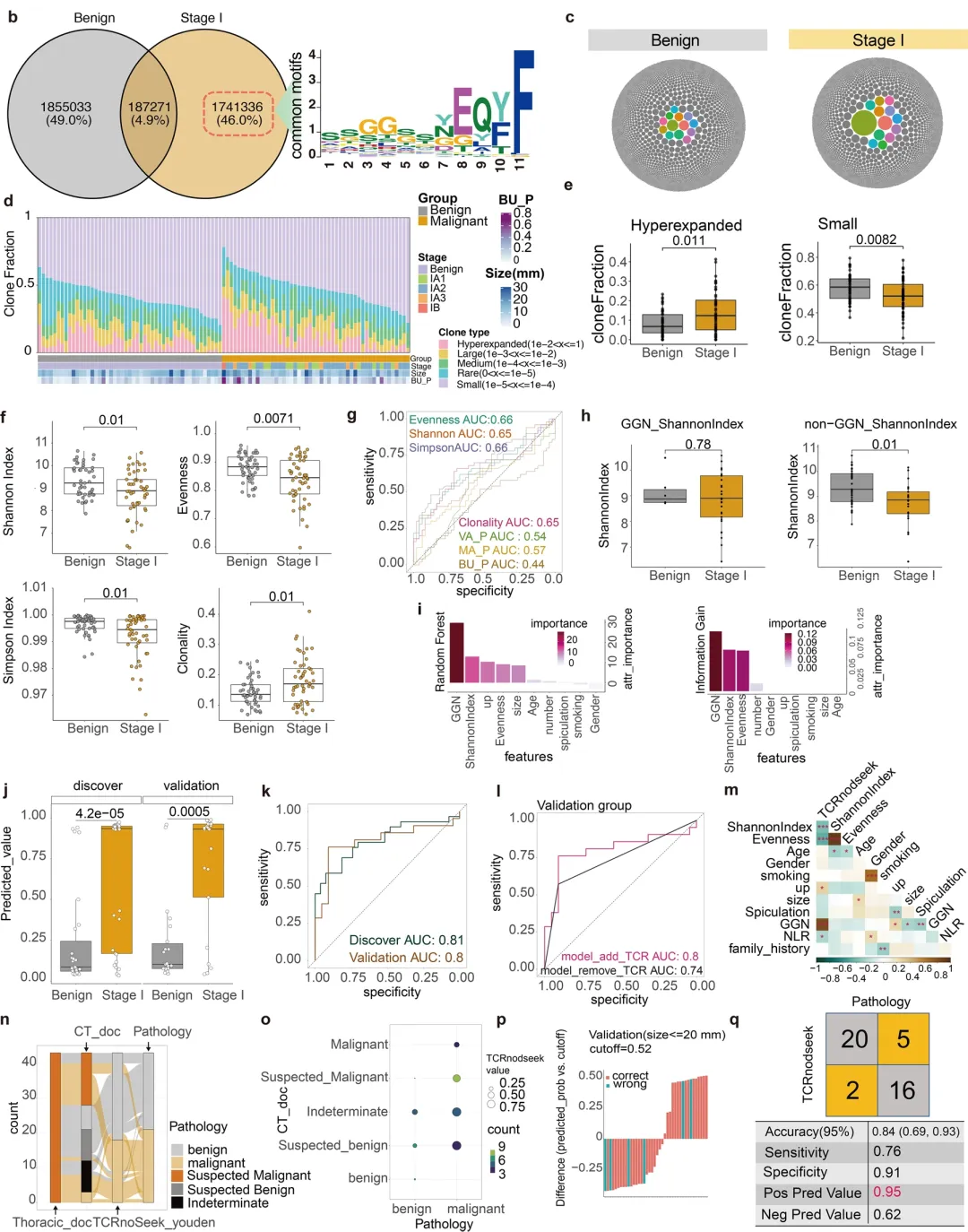
(Figure 1b–q)
Next, we constructed a robust support vector machine model and optimized its parameters using a genetic algorithm; we named this model TCRnodseek, an acronym for "TCR-based model seeking to distinguish benign from malignant nodules." TCRnodseek performed well in both the discovery and validation groups (AUC values of 0.81 and 0.80, respectively; Figure 1j, k). In the validation group, the AUC value of the model without TCR features dropped to 0.74 (Figure 1l).
Conclusions
In conclusion, we have developed the TCRnodseek model, which integrates TCR diversity and clinical information to distinguish benign from malignant lung nodules more accurately. In addition to providing evidence for diagnosis, information on CDR3β might benefit the development of CAR T-cell therapy.
Based on the findings of this first-phase study, HaploX, together with Sichuan Cancer Hospital and Peking University Shenzhen Hospital, has launched a multicenter clinical study (ChiCTR2200055761) to validate and optimize this model, thereby benefiting more patients with lung nodules.